Buying Wholesale Colored Contact Lenses in 2026 requires more than comparing prices and attractive color charts. These products touch the eyes, so comfort, safety, traceability, and legal compliance must guide every purchasing decision. A low price may hide weak quality control, unclear materials, or incomplete documentation.
Reliable buyers should examine suppliers carefully. Check business registration, manufacturing records, product specifications, and independent quality certificates. Request samples before placing a large order. Inspect the packaging, lens texture, color consistency, and solution compatibility. Ask whether the lenses are made for cosmetic use, vision correction, or both. Requirements can vary significantly between countries and regions. Always confirm local rules with the relevant health authority or licensed professional.
Small details matter. A sealed box should show clear batch information, expiry dates, wearing instructions, and manufacturer details. The supplier should explain storage conditions and provide responsive support. Professional communication is a useful trust signal, but it is not proof of quality. Verify the evidence.
Some buyers focus too heavily on popular shades. That can be a costly mistake. Customer comfort, realistic demand, and return risks deserve equal attention. Even experienced purchasers can overlook fit differences between models. Therefore, collect feedback from wearers and review complaints honestly. Not every attractive lens performs well in daily use.
This guide explains how to compare suppliers, evaluate samples, estimate costs, and build a safer purchasing process. It also highlights common mistakes in wholesale sourcing. The goal is not merely a larger order. It is a dependable product that meets documented standards and protects customers.
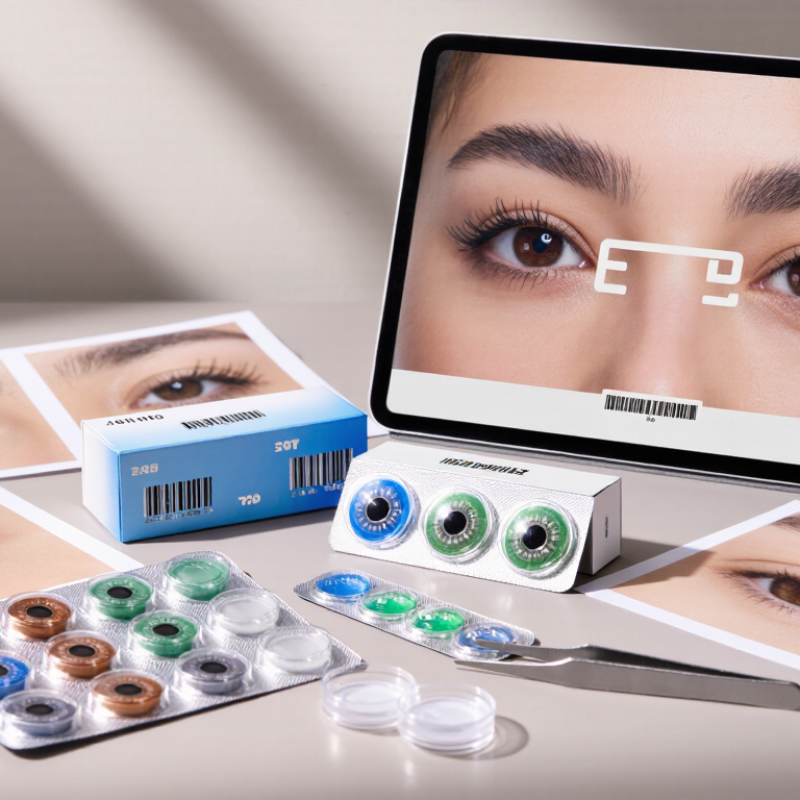
Before requesting wholesale colored contact lenses, define the wearer and sales requirements clearly. Colored contacts are not one-size-fits-all products. Record prescription ranges, plano needs, base curve, diameter, and replacement schedules. A qualified eye-care professional should review fitting requirements. Sample testing can reveal edge movement, dryness, or blurred vision that a catalog cannot show. Keep these findings in a written specification sheet.
Describe the visual result with equal care. Note the desired color opacity, pattern, pupil opening, material, water content, and tint stability. Packaging also matters. Specify individual blister packs, labeling languages, shelf-life expectations, and storage conditions. Small details matter. A lens may look attractive in a photograph but appear unnatural under indoor lighting. Request samples in several colors and inspect them under daylight, office light, and camera flash.
Set commercial requirements before comparing suppliers. Include minimum order quantities, target costs, delivery windows, forecast volumes, and acceptable defect rates. Ask for lot traceability, quality-control records, sterilization information, and conformity documents required in your market. Requirements differ by country, so verify them with local regulators or qualified professionals. Do not accept vague answers about safety or manufacturing. A forecast is rarely perfect, and that is worth admitting. Begin with a smaller validated order when possible, then revise quantities after reviewing returns, customer feedback, and fit-related concerns.
Wholesale colored contact lenses require more than attractive shades and low prices. In many regions, even non-prescription lenses require professional fitting or a valid prescription. Check the rules where you will sell and where customers will wear them. Confirm power ranges, base curve, diameter, material, and oxygen permeability. Request complete labeling, lot numbers, expiry dates, and storage instructions. A sample pair should arrive sealed, clean, and clearly traceable.
Supplier credentials deserve careful review. Ask for business registration, medical-device authorizations, quality certificates, and documented manufacturing locations. Verify certificates through the issuing organization when possible. Request test reports for sterility, pigmentation stability, biocompatibility, and packaging integrity. Reliable suppliers should explain complaint handling, recalls, and replacement procedures. A polished website proves very little. I would not trust product photos alone, because packaging can hide missing safety information.
Tips: Start with a small test order. Inspect every box and lens. Compare documents with the actual packaging. Ask who handles adverse-event reports. Do not sell lenses with unclear prescriptions, damaged seals, or incomplete instructions. My earlier assumption was that certification automatically meant safety, but that is too simple. Certificates can be outdated, limited in scope, or unrelated to the exact product. Keep written records of verification, batch details, and supplier responses before placing a larger order.
How to Buy Wholesale Colored Contact Lenses in 2026?
Comparing wholesale manufacturers requires more than checking the lowest unit price. Review material specifications, lens dimensions, color consistency, packaging, and production controls. Ask for current quality documents and market-specific compliance records. Colored contact lenses may require prescriptions or regulatory approval, depending on the destination country. Confirm these requirements before placing an order.
Minimum order quantities can range from a few hundred pairs to several thousand. A low MOQ may suit a small online store, but the unit price is often higher. Larger orders usually reduce costs, though slow-moving colors can trap working capital. Request a tiered quotation showing prices for 500, 1,000, and 5,000 pairs. Also check sample fees, packaging charges, shipping terms, and replacement policies.
Do not trust photos alone. Request physical samples and inspect the edges, print alignment, comfort, and package sealing. A supplier with responsive communication is easier to manage when defects appear. Still, responsiveness is not proof of quality. That is an easy mistake. Compare at least three manufacturers using the same specifications. Record every promise in writing, including lead time and acceptable defect rates. A cheaper offer may become expensive after delays, failed inspections, or unsold colors. Small test orders are safer, although they may not reveal long-term performance.
| Supplier Profile | Typical Product Range | Typical Wholesale Price per Pair* | Typical MOQ | Private-Label Capability | Typical Production Lead Time | Common Compliance Documentation | Best Fit for Buyers |
|---|---|---|---|---|---|---|---|
| Large, high-volume manufacturer | Monthly and daily disposable colored lenses; prescription and plano options; standard color collections | US$1.20–US$3.50 | 500–5,000 pairs per design | Yes; custom packaging and selected colors are commonly available | 30–60 days after artwork and specifications are approved | ISO 13485 certificate, product test reports, sterilization records, packaging specifications, and market-specific regulatory files | Distributors, established e-commerce sellers, and retailers seeking the lowest unit cost |
| Mid-sized contract manufacturer | Monthly lenses, prescription ranges, cosmetic tints, and customized packaging | US$1.80–US$5.00 | 200–1,000 pairs per design | Yes; moderate customization of color, blister, carton, and label | 25–50 days after final approval | ISO 13485 or equivalent quality-system evidence, certificate of analysis, stability information, and batch traceability documents | Growing brands that need product customization without very large purchase volumes |
| Small-batch OEM/ODM supplier | Limited monthly collections, fashion colors, plano lenses, and short-run promotional products | US$2.50–US$7.00 | 100–500 pairs per design | Usually available; packaging customization is more common than new lens-formula development | 20–45 days after design confirmation | Product specifications, lot documentation, material information, packaging proofs, and applicable local registration documents | Start-ups, boutiques, test launches, and buyers validating demand before scaling |
| Ready-stock wholesale distributor | Pre-existing colored lens designs; usually plano or limited prescription ranges | US$2.00–US$8.00 | 10–100 pairs per SKU | Generally unavailable; standard packaging is supplied | 2–10 business days when inventory is available | Invoice, lot number, expiry information, product labeling, and available conformity or registration documents | Small retailers and buyers who prioritize speed and low inventory risk |
| Premium specialty manufacturer | High-oxygen-permeability materials, advanced pigmentation, toric or multifocal options, and premium prescription ranges | US$5.00–US$15.00+ | 100–1,000 pairs per design | Sometimes; custom development may require technical validation and higher tooling costs | 45–90 days for customized products | Detailed technical file, material and pigment information, biocompatibility data, clinical or performance evidence where required, and quality-system documentation | Optical retailers and specialist sellers competing through product performance and prescription coverage |
*Prices are indicative 2026 wholesale ranges in U.S. dollars for bulk purchasing and may vary according to lens type, prescription coverage, packaging, shipping terms, tooling, testing, duties, and destination-market requirements. Colored contact lenses may be regulated as medical devices, including plano lenses, so buyers should verify local prescription, labeling, import, and registration rules before placing an order.
When buying wholesale colored contact lenses in 2026, review physical samples before discussing volume pricing. Check color consistency, edge smoothness, lens flexibility, and comfort after a qualified professional evaluation. A glossy sample can still hide poor tint distribution. Small details matter. Request samples from different lots, not only one production batch. The U.S. FDA classifies decorative contact lenses as medical devices, including lenses without vision correction. CDC data estimates that about 45 million Americans wear contact lenses, showing the importance of reliable quality control. These figures should encourage careful sourcing, not rushed purchasing.
Packaging should show the lot number, expiry date, material, wear schedule, storage instructions, and responsible manufacturer details. Compare every sample with its printed information. For shipping, confirm sealed cartons, moisture protection, tracking, and documented handling conditions. Ask whether delays can affect sterility or packaging integrity. The International Air Transport Association reports that global air cargo carries more than 60% of world trade by value, but speed does not guarantee careful handling. A practical weakness in many wholesale agreements is vague return language. Require written terms for damaged cartons, incorrect colors, manufacturing defects, and unopened returns. Clarify who pays freight and how quickly refunds or replacements occur. Do not accept opened products for resale. That assumption deserves review. The safest supplier provides traceable documents and responds clearly when something goes wrong.
How to Buy Wholesale Colored Contact Lenses in 2026?
Wholesale purchasing should begin with documented quality controls, not attractive color charts. The U.S. Centers for Disease Control and Prevention reports that about 45 million Americans wear contact lenses. That user base demands consistent safety. The U.S. Food and Drug Administration also classifies decorative lenses as medical devices. Therefore, buyers should verify local prescription, labeling, and import requirements before ordering.
Request product samples from every production lot. Check lens diameter, base curve, color consistency, moisture retention, packaging seals, and expiration dates. Ask for test reports covering sterility, biocompatibility, and material specifications. Keep the supplier’s certificate, lot number, inspection photos, and approved sample together. Small details matter.
Use a written purchase specification. Include acceptable quality limits, defect definitions, carton requirements, and shipment records. Independent pre-shipment inspection can compare random units against the approved sample. AQL sampling helps, but it cannot replace professional judgment. Do not trust one successful delivery.
The Global Market Insights 2023 report estimated the contact lens market above USD 10 billion globally, showing strong commercial demand. Growth can also increase shortcut risks. Review complaint rates after each shipment. Retain samples for future comparison. A supplier may pass one inspection and fail the next. That possibility deserves a response plan, not optimism. Reorder only after reviewing quality records, customer feedback, and corrective actions.
Record prescription ranges, plano needs, base curve, diameter, material, water content, and replacement schedules. A qualified eye-care professional should review fitting requirements.
Request samples in several shades and inspect them under daylight, office lighting, and camera flash. Photos can mislead. Check opacity, pupil opening, pattern, and tint stability.
Specify individual blister packs, labeling languages, shelf-life expectations, storage conditions, and carton requirements. Inspect package seals and expiration dates carefully.
Compare at least three suppliers using identical specifications. Review materials, dimensions, color consistency, production controls, quality records, and delivery terms. Responsive communication helps, but it does not prove quality.
Lower quantities may suit smaller stores but often increase unit costs. Larger orders can reduce prices while trapping money in slow-moving colors. Request prices for 500, 1,000, and 5,000 pairs.
Check sample fees, custom packaging, shipping, inspection, replacement policies, and possible delay costs. A cheaper offer may become expensive after failed inspections or unsold colors.
Compare random units with the approved sample. Check diameter, base curve, color alignment, moisture retention, sealing, expiration dates, and visible defects. Independent inspection can help. It cannot replace professional judgment.
Request material specifications, sterility and biocompatibility reports, conformity documents, lot numbers, and quality-control records. Keep inspection photos and approved samples together. Do not accept vague safety claims.
Usually, begin with a smaller validated order when possible. Review returns, customer feedback, fit concerns, complaint rates, and corrective actions before reordering. One successful shipment proves little. My forecast may be wrong.
Buying Wholesale Colored Contact Lenses in 2026 requires careful planning, product evaluation, and supplier verification. Start by defining your needs, including lens colors, materials, prescriptions, packaging formats, expected order volume, and target customers. Before comparing offers, confirm that each product meets applicable safety and quality standards, and check whether prescription lenses require documentation or professional oversight in your market. Supplier credentials, manufacturing transparency, testing records, and communication quality should also influence your decision.
Next, compare manufacturers based on pricing, minimum order quantities, customization options, production capacity, and delivery reliability rather than price alone. Request samples to assess comfort, color accuracy, packaging quality, labeling, and consistency. Review shipping terms, inspection procedures, return policies, and solutions for defective or delayed goods before placing an order. After purchase, maintain organized quality-control records, inspect every shipment, and document customer feedback. This process helps reduce risk, support regulatory compliance, and build a dependable purchasing strategy for future wholesale orders.